Why revision is harder than the first operation
Three things change once a nose has been operated on.
Scar tissue. The planes a surgeon works through are no longer clean. Tissue that separated easily the first time is now adherent and less predictable, and the skin envelope has usually lost some of its ability to redrape.
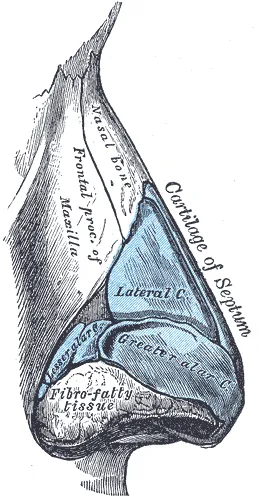
Missing structure. Most unsatisfactory results follow removal of too much cartilage or bone. That support has to be rebuilt before the nose can be reshaped, which means grafting.
Less margin for error. In a primary rhinoplasty there is usually some cartilage to spare. In a revision there often is not, and the changes are measured in fractions of a millimetre against tissue that behaves less predictably.
This is why revision takes longer, why it needs more planning, and why the result takes longer to settle. It is often also helpful to obtain the operation notes from your previous surgery. Knowing what was done, and what was taken, changes the plan.
What can be corrected, and what is harder
Potentially correctable: a residual or over-resected dorsal hump, asymmetry, a nose that remains deviated, an over-rotated or under-projected tip, irregularities that can be felt or seen along the bridge, and breathing obstruction caused by loss of support.
Improvable rather than fully correctable: thick skin that will not redrape over a refined framework, significant loss of skin quality, and results where a great deal of the underlying structure has been removed. These can be made better. They may not be made to look as though the first operation never happened.
If I do not believe I can deliver a worthwhile improvement, I will tell you at consultation, and I will say why.
Rebuilding support
Most revisions need cartilage. Where it comes from depends on what is left.
Septal cartilage is useful where enough remains, since it handles well and needs no second surgical site. In revision it has often already been used, so it is frequently not available in the amount needed.
Rib cartilage is often the preferred route in revision, because so much of the framework has usually been removed by the first operation. It provides strong, plentiful, straight material, which is what rebuilding a nose needs. It also means a second incision, more discomfort in the first week, and a longer operation.
Ear cartilage is used where a smaller graft will do. It is curved rather than straight, which suits some purposes better than others, and taking it leaves the shape of the ear unchanged.
Which of these applies is a decision made at consultation and confirmed at surgery, since what is available is not always fully known until the nose is opened.
Timing
Wait at least twelve months from your last operation, and often longer.
The reason is not caution for its own sake. A nose continues to change for a year and more, particularly at the tip and particularly in thicker skin. Noses that look irregular at three months frequently settle. Operating into swelling means operating on a nose that is not yet the nose you will have, and the risk of making things worse rather than better is real.
The exception is a functional problem that is not going to improve with time, or an obvious structural collapse. Those can be assessed sooner.
Breathing
A large proportion of the revision patients I see have breathing problems as well as appearance concerns, and often the two have the same cause. Over-resection of the framework narrows the internal valve, and a nose that has been made too small from the outside is frequently too small on the inside as well.
Where that is the case, the reconstruction addresses both at once. The airway is assessed directly at consultation rather than by history alone.
What to bring
If you can obtain them, they make a material difference:
- The operation note from your previous surgery
- Photographs taken before your first operation
- Any correspondence about what was planned
These are not essential before your first consultation, and I understand that asking a previous surgeon for records can be uncomfortable. But knowing what was done is more useful than any amount of inference from examining the result.
Where I operate
I operate at Herston Private Hospital, Mater Private Hospital Springfield and Westside Private Hospital. I consult at rooms in Indooroopilly, Ipswich and Springfield.
Patients travelling from outside Brisbane
Revision patients travel further than most, and I see people from the Gold Coast, the Sunshine Coast, across Queensland and interstate. The first consultation is ideally in person, because it is typically a full examination, including the airway with a small camera (endoscopy). It can be done by video, in which case the examination happens at the second consultation, in person. The second visit also focuses on photo morphing and on answering your questions, and there is a required cooling off period of at least seven days after both consultations and signed consent, during which surgery cannot be booked or a deposit taken, so the trip needs planning.
You will be reviewed here between seven and ten days after surgery, and you cannot fly for two weeks after surgery.
If anything is concerning you once you are home, contact my rooms directly. Your care stays with the surgeon who operated on you.
Risks
Revision rhinoplasty carries the same risks as primary surgery, and in some respects a greater share of them. Scar tissue, compromised blood supply and grafted material all make healing less predictable. A proportion of revision patients need a further procedure.
The full discussion of risks and expected recovery is set out on the risks and side effects answers and forms part of every consultation.
Consultation
I do not offer surgery to everyone who consults me, and that is more often true in revision than in primary work. I will only proceed where I am confident that surgery can deliver a worthwhile and lasting improvement. Where I do not think that is the case I will say so directly, and I may suggest waiting, a different approach, or a second opinion.
Cosmetic surgery in Australia requires a referral (preferably from your usual GP, or from another GP or specialist who works independently of me), at least two consultations with at least one in person with me, and a cooling off period of at least seven days that runs after both consultations and signed consent. Surgery cannot be booked, and no deposit taken, until it has ended.
Results
Before and after photographs of revision patients are in the gallery, with the time since surgery stated for each. Results vary between patients and no surgical outcome can be guaranteed. The first operation, where there has been none before, is described on my rhinoplasty page.