What it is
A soft gel, almost always hyaluronic acid, injected into the skin and soft tissue over the nasal skeleton. It sits above the bone and cartilage rather than altering either. The effect is visible immediately. It is usually called temporary, and that word needs more care than it normally gets, and the section on what temporary means explains why.
I do not offer it, and I am not the person to ask for it. My practice is surgery of the nose. I can tell you accurately what filler does, but I cannot offer it.
Filler adds. Surgery can also take away
This is the distinction that decides whether it is of any use to you, and it is the one most often left out.
Filler can only add volume. It cannot remove anything. So a bump on the bridge is not reduced by filler. What happens instead is that gel is placed above and below the bump until the profile reads as a straighter line, which disguises the bump by making the whole bridge slightly higher. For a small bump on a nose that is otherwise not prominent, that can look reasonable. On a nose that is already large, adding to it to hide a hump works against you.
Surgery does the opposite. The bump is taken down by reducing the bone and cartilage that form it, and the bridge is narrowed to match. That is a smaller nose rather than a smoother larger one.
Temporary describes the effect, not the material
The visible change softens over something between six and eighteen months. That is the figure you will be quoted and it is a reasonable guide to how long it looks as though it worked.
What happens to the gel itself is a different question, and the imaging does not support the idea that it always disappears. The best evidence is from the mid-face rather than the nose. In a 2024 series of 33 patients who had MRI scans after hyaluronic acid filler in the cheeks and mid-face, filler was still present in every one of them and none had cleared by two years; in some it was still there eight to fifteen years later. Nine of those patients were scanned because of swelling, so the group was not a random sample. A 2026 three-dimensional MRI study found that the volume of filler detectable in the tissue was typically well above the volume originally injected, because the gel is hydrophilic and holds water around it. How much of this applies to the nose is not known, and it is not a reason to assume that every filler lasts for years.
So the effect fading and the filler leaving are two different events, and the first happens a long time before the second. Two things follow from that, and they are the reason it matters rather than being a technicality.
It can move. Filler can end up somewhere other than where it was placed, and migration from the nose to the forehead has been reported. A soft lump appearing months or years later, somewhere nobody injected, is a recognised presentation and is easy to mistake for something else.
It can provoke a delayed reaction. As the gel breaks down into smaller fragments it can be presented to the immune system. Delayed-onset nodules are a recognised complication, usually appearing from four weeks to beyond a year afterwards, sometimes later.
Dissolving filler with hyaluronidase is possible and it is not the same as the filler never having been there. If you are told the effect simply wears off and nothing remains, that is not what the imaging shows.
What it will not change
- A deviated septum. The septum is the wall inside the nose. Filler goes outside it.
- A nose that is wide. Adding volume does not narrow anything.
- A tip that has dropped much. Tip position is held by cartilage and by the support beneath it. Filler can lift a tip very slightly and cannot rebuild its support.
- Anything about your breathing. See below, because this is the part that matters most and gets the least attention.
It does nothing for the airway
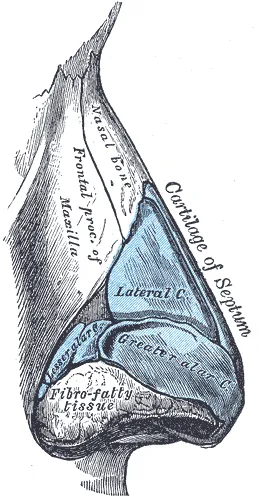
The airway is assessed at every consultation, whatever the reason for the appointment. Breathing through the nose is governed by the septum, by the turbinates on the side walls, and by the nasal valve, which is the narrowest part of the whole airway and sits just inside the nostril. All three are internal structures.
Filler placed in the skin envelope does not reach any of them. If your nose is blocked, filler will not help, and a nose that looks straighter while breathing the same is not a result I would call an improvement.
Some people come in believing a crooked nose and a blocked nose are one problem with one answer. They are often related and they are not the same thing, which is why both get assessed before anything is recommended.
The risk worth understanding
Filler in the nose is not the same risk as filler in a lip or a cheek. The nose is supplied by small end-arteries with limited alternative supply. If filler is injected into or compresses one of those vessels, the blood supply to an area of skin can be lost. That causes skin breakdown, and in rare cases filler in the nasal or surrounding vessels has caused permanent loss of vision.
The anatomical reason is this. The vessels around the nose connect backwards into the internal carotid circulation by way of the orbit, which is how filler reaches the eye, and into the external carotid circulation through the facial arteries. That is why the nose is one of the few sites on the face where this risk is taken as seriously as it is.
This is uncommon. It is also the reason the procedure is not trivial, and the reason it should only ever be done by someone who knows the vascular anatomy of the nose and has hyaluronidase, the enzyme that breaks down hyaluronic acid filler, immediately to hand.
If I were having filler injected into the nose, I would want ultrasound guidance. High-frequency Doppler maps almost all of the facial arteries before a needle goes in. Afterwards it separates filler sitting inside a vessel from filler pressing on one from the outside, shows where the gel actually is, and guides hyaluronidase to it rather than flooding the region blind. In published ultrasound-guided cases of filler-related blocked blood flow, the doses of hyaluronidase that worked were small, around 30 to 150 units, and lower than the doses used when the filler cannot be seen.
It is worth asking any practitioner about this, and about what would be done if the skin blanched during the injection.
It can make later surgery harder
Filler is not always a neutral first step. Repeated injection leaves scar tissue in the soft tissue over the nasal skeleton, and that tissue is exactly what has to be lifted cleanly during an operation. Scarred planes make the dissection less predictable and can affect how the skin settles afterwards.
If you think you may want surgery eventually, that is worth weighing before you start a course of injections rather than afterwards.
What I would do instead
Work out what is actually causing the thing you do not like, and tell you whether an operation would change it.
I do not offer surgery to everyone who consults me. A consultation is an assessment, not a surgery booking. Sometimes the change you want is small enough that no operation is worth its recovery, and if that is the answer you will get it.
If the answer is surgery, the relevant pages are rhinoplasty for the shape of the nose and septoplasty for the septum and the airway. Where both matter, they are usually done in the one operation.